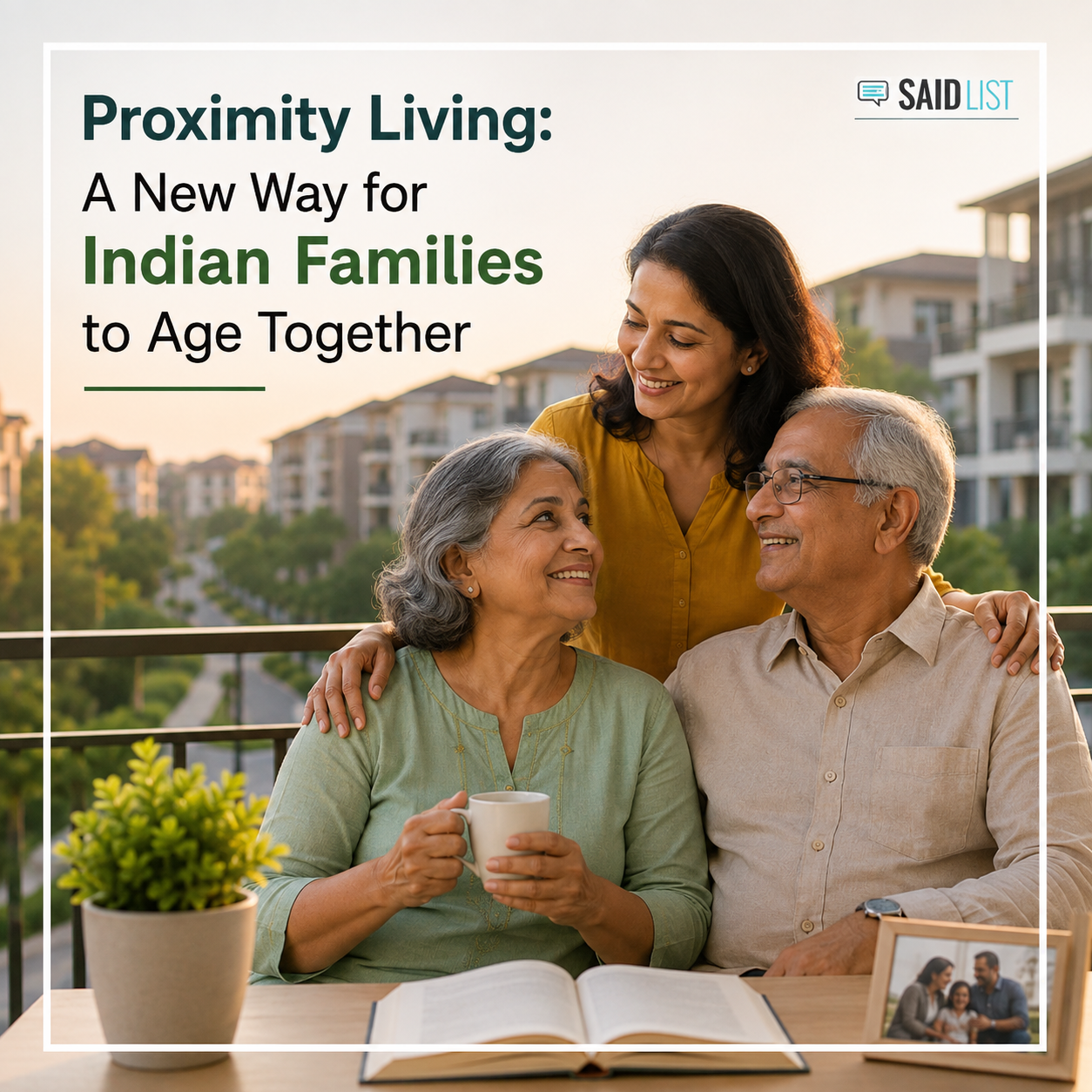
For many Indian families, ageing parents and adult children living under one roof has long been seen as the natural choice. But as family life changes, another possibility is gaining attention: living close to each other while maintaining separate homes.
While exploring how Indian families are rethinking life after 50, I came across a surprisingly simple idea on GreySmiles: Proximity Living.
The idea addresses a question many families quietly face. How can ageing parents stay close to their children without giving up their independence?
Children move to different cities for work. Homes are getting smaller. Both spouses often have demanding careers. At the same time, today’s older parents often want something their parents may not have asked for as openly: independence without distance.
That is what makes Proximity Living interesting.
What Is Proximity Living?
Proximity Living means parents and their adult children living close enough to remain part of each other’s daily lives while maintaining separate homes, routines and identities.
They might live in the same neighbourhood, the same housing complex or within a short drive of each other.
The arrangement offers something between traditional joint-family living and complete independence.
Parents have their own space. Children have their own homes and routines. Yet family members remain close enough to meet regularly, help each other and respond quickly when needed.
It is a simple change in how families think about living arrangements after 50.
Why Indian Families Are Rethinking Living Arrangements?
The traditional idea of family living has changed considerably.
A son or daughter might now work in another city. Couples may live in apartments designed for smaller households. Grandchildren may grow up in a different part of the country. Parents themselves may want to travel, pursue hobbies or maintain an active social life after retirement.
Living together under one roof is therefore not always practical or desirable.
But living far away has its own challenges.
Distance can make everyday family involvement harder. A parent might need help with a small task. A child might want to check in after work. Grandchildren might want to visit their grandparents without planning an entire trip.
Proximity Living offers another option: staying independent while remaining within easy reach of family.
Independence Without Losing Family Connection
One of the strongest aspects of this model is the balance it creates.
Parents do not have to feel that moving closer to their children means becoming dependent on them. They retain their own home, schedule and personal space.
Adult children also remain available without having to reorganise their entire household around caregiving.
The relationship remains family-oriented while allowing everyone to maintain a degree of independence.
This could mean having Sunday lunch together, seeing grandchildren after school, helping with groceries, sharing a festival celebration or simply dropping by for a cup of tea.
Sometimes, being nearby matters more than living together.
The Everyday Benefits of Living Close to Family
The value of Proximity Living is not limited to emergencies or caregiving.
It is also about the ordinary moments that keep families connected.
A parent might see a grandchild several times a week instead of a few times a year. Children might be able to check on their parents without making a long journey. Families could share meals, celebrations and small responsibilities more naturally.
Being ten minutes away creates a different kind of family life than being ten hours away.
At the same time, separate homes provide privacy and personal freedom.
That balance could become increasingly important as more Indian parents enter retirement with their own interests, routines and expectations for life after 50.
Why Proximity Living Could Work Particularly Well in India
Family remains an important part of life for many Indians, even as living patterns change.
This creates an interesting opportunity for housing and retirement planning.
Families do not necessarily have to choose between joint-family living and complete independence.
A parent could live in the same residential complex as their daughter. A retired couple could move into a nearby apartment after their son settles in another part of the city. Siblings could choose homes within the same neighbourhood so that ageing parents remain close to everyone.
The physical distance becomes smaller without removing personal boundaries.
It does not reject the family. It reimagines how the family can live.
Independent Proximity: A Different Way to Think About Ageing
GreySmiles describes this broader approach as Independent Proximity.
At its heart is a straightforward idea: later-life living does not have to mean choosing between family connection and personal independence.
Both can exist together.
Parents can have their own homes and routines while staying close enough to their children for regular interaction and support.
For adult children, it offers reassurance without requiring everyone to share one household.
For grandchildren, it can create more opportunities to build relationships with grandparents through everyday contact.
And for families as a whole, it offers another way to think about ageing, retirement and where different generations should live.
How Close Is Close Enough?
Perhaps this is the more useful question for families to ask.
Instead of asking, “Should ageing parents live with their children?”, families could ask:
“How close would we like to live to the people we love?”
For one family, the answer could be the same apartment complex.
For another, it could be the same neighbourhood.
For someone else, a 15-minute drive might be enough.
There is no single arrangement that works for every family. The important part is finding a distance that allows connection while respecting everyone’s need for independence.
The Future of Family Living in India
The Indian family is changing, but the desire to stay connected has not disappeared.
As more people live longer, retire differently and move between cities, families may need new ways to organise their lives across generations.
Perhaps the future Indian family will not always live under one roof. Perhaps it will simply live close enough to be there when it matters.
Proximity Living offers a small shift in thinking with a meaningful question at its centre: Can families stay deeply connected without giving up the freedom of separate homes?
For many families, the answer could be yes.
Read more about Independent Proximity on GreySmiles: Independent Proximity and the retirement living model